Eguisheim, a medieval village
Ranking since 2004 among "the Most Beautiful Villages of France".

The House Léon Baur is an eight-hectare family estate located in a medieval village called Eguisheim (Haut-Rhin), known as the birthplace of winegrowing in Alsace. Eguisheim also got four stars for its streets and buildings decked out with flowers and it was twice awarded the "Grand Prix National du fleurissement".
In 1002, the family of the Counts of Eguisheim gave birth to Bruno of Eguisheim, who was to become a Pope in 1048 in Rome under the name of Leo IX.
The surrounding ramparts with their fabulously coloured and flower-decked houses as well as the castle of the Counts makes that village an important scene in the history of Alsace and a fine jewel in the Alsatian tourism.
It is at the heart of these medieval ramparts that you will find our cellar, whose walls still show three loopholes, and it is there that our different types of vines and vintages are developed with great care and the respect of the traditions of Alsace.


Eguisheim I The House Léon Baur I The winegrower’s job I The wine-tasting cellar


The House Léon Baur,
a family heritage for 9 generations

The origin of our house dates back to 1731, 7 years before its official creation, when Jean-Jacques Baur bought his first 48-are plot of land at the small lieu-dit called Stribicher, located in the Grand Cru Eichberg.
The small estate was handed down from generation to generation and is now composed of 8 hectares divided up as follows into 37 plots of land :
• AOC ALSACE : (AOC = Appellation d’Origine Contrôlée, a label guaranteeing the quality of the wines): 5.50 hectares distributed among the vineyards of Eguisheim and Ammerschwihr.
• AOC ALSACE GRAND CRU : 2 hectares in the Grands Crus Eichberg and Pfersigberg in Eguisheim.
• Lieu-Dit Kaefferkopf : 0.50 hectare in Ammerschwihr.

The House Léon Baur, founded in 1738, has been run by Jean-Louis Baur, 55, since 1976. The Alsace wines are maturing in the wooden tuns of the old cellars located under the ramparts of the village.
However, the estate is turned towards progress, among others with their stainless steel vats that are thermo regulated for vinification, a pneumatic wine press, a wine-making process for dry wines with the typicality of the wines being respected.
The winegrowing work is respectful of the soil: there is a ploughed-up row for the aeration of the soil, alternating with a grassed-over row for an optimum absorption of the mineral elements and a better control of the yield. “Sexual fusion”, which is an ecological means to fight the disease of grape worms, is used whenever the environment makes it possible. In the summer, the ”green” grape harvest is carried out as well as a thinning-out of the leaves if necessary. The harvesting is done by hand. All the vineyard and cellar work is done by the Baur family with the help of a salaried employee who has been working with them for 20 years. The whole harvest is bottled and sold by the House Léon Baur.


Eguisheim I The House Léon Baur I The winegrower’s job I The wine-tasting cellar

The winegrower’s job

“ Be it in our vineyards or in our cellars, it is throughout the year and to the rhythm of the seasons that we are working so as to achieve an optimum grape harvest and to elaborate our wines according to our strict criteria”.

The winter months

The pruning season : a vine before the pruning and cut back to two “sticks” (the cutting back is called in “Guyot double”). It is manual work that is often done in rigorous weather conditions, which is why it is laborious.

The organic manuring : the winter ploughing makes the ground less compact and prepares it for the year to come.

Miscellaneous upkeep : the stakes are being repaired and replaced.

In the cellar : the first bottling session is performed at the end of the winter.

The spring months

The arching of the small branches : the branches are being arched so that the sap is distributed uniformly among the different buds.


Early April : the buds are starting to open.

May : beginning of the vegetative phase.

The thinning-out of the vines : the regrowth at the foot of the vine is removed by hand.

Ploughing : the spring ploughing is aimed at aerating the ground and preventing the growth of weeds.

Planting : young vines are being planted and the diseased vines are being replaced.

The summer months

June-July : the flowering.

Mid-June : the vines are in bloom. The fertilization will lead to the forming of the grapes; it is a delicate stage which often conditions the harvest to come (weather conditions; the frost factor).


The espaliering and the trimming of the vines :
June and July are also periods of intense work. A tractor is used to put up wires that will draw the vine branches back up and then cut them with giant-size shears fixed on the tractor (it is the trimming of the vines).

Treatment : summer is also the season for different treatments, mainly for copper and sulphur treatments against the main enemies of vines, namely powdery and downy mildew. Several treatments are necessary throughout the summer months, as these fungi can cause the total loss of the harvest as well as the destruction of the vine.

Weeding : it consists in removing the weeds which compete with the vine for water and nutrients.

Mowing : as our vineyards have 50% grassed-over rows, it is necessary to regularly cut the grass.

The ripening of the grapes : the vegetative growth of the vine stops; only the grapes go on ripening until early October; they become translucent and take their final colour.


The autumn months

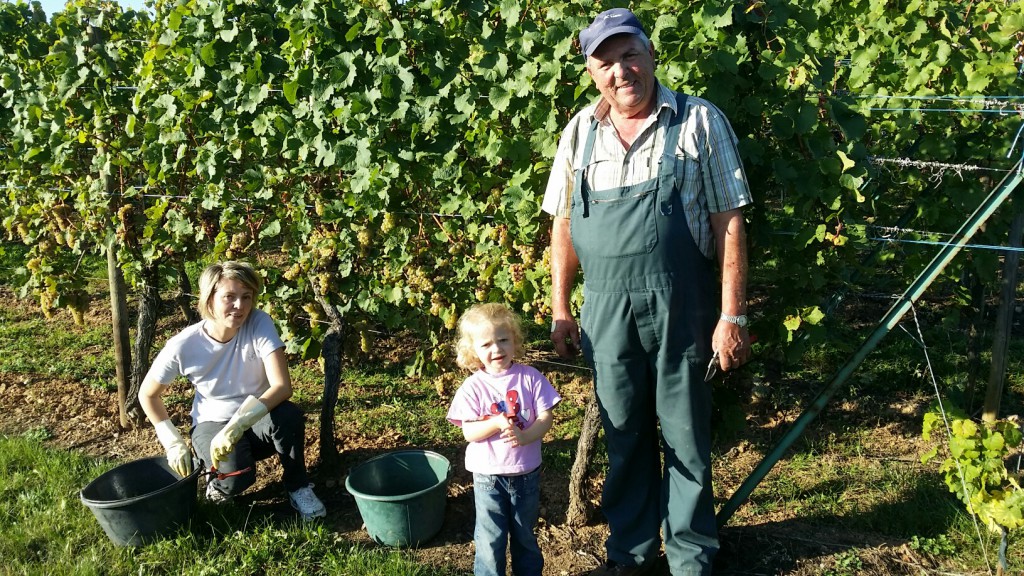
The harvesting : after preparing and cleaning the cellar (the grape pickers’ baskets, the vats), a team of 20 or so people is going to harvest by hand the different grapes as they get ripe. The grape pickers sort out the grapes as they go along in order to eliminate the rotten or unripe grapes.
In the cellar : the fermentations and the vinifications are being monitored daily: fining, filtration, the removal of the espaliering wires. In addition, the bottles must be washed, labelled and sealed, the orders must be prepared and the wines must be marketed.


Eguisheim I The House Léon Baur I The winegrower’s job I The wine-tasting cellar

The wine-tasting cellar

Marie-Antoinette Baur and her daughter Caroline welcome the customers every day in their recently opened wine-tasting and sales cellar. The wines are directly sold from the cellar to the French and worldwide private customers, and 20% of the production is exported to Germany, Belgium, Finland, Switzerland and Denmark.


<Page up>